

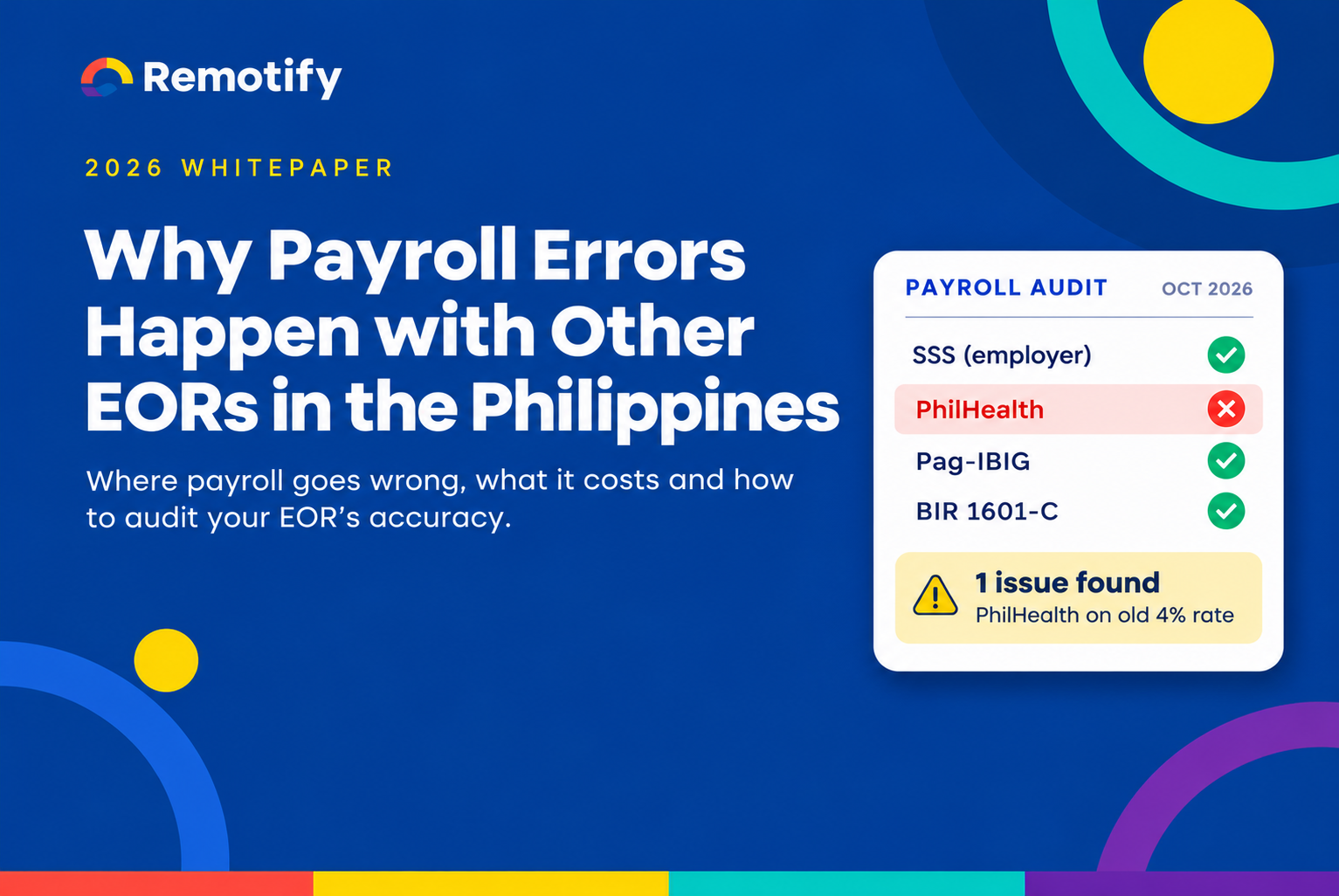
Outsourcing payroll to an Employer of Record (EOR) should make managing your Philippine workforce easier. But incorrect statutory contributions, missed government deadlines, outdated tax calculations and unverified remittances can create costly compliance issues for your business.
Remotify's 2026 Whitepaper: Why Payroll Errors Happen with Other EORs and How to Audit Their Accuracy helps you understand where Philippine payroll providers go wrong, the financial and operational impact of payroll mistakes, and how to verify whether your EOR is managing payroll accurately.
What's inside the whitepaper?
- Common payroll errors: Identify mistakes in SSS, PhilHealth and Pag-IBIG contributions, tax withholding, 13th-month pay and payroll calculations.
- Why EORs make payroll mistakes: Understand the risks of outdated systems, limited local expertise, overstretched account managers and a lack of remittance transparency.
- The real cost of payroll errors: Explore potential penalties, back payments, employee disputes, compliance issues and reputational damage.
- Philippine payroll compliance: Understand statutory contribution calculations, government filing deadlines, payroll currency requirements and data privacy obligations.
- 10-step payroll audit framework: Learn how to independently review your EOR's payroll accuracy, statutory deductions, remittances and tax filings.
- Ready-to-use Payroll Audit Checklist: Access a practical monthly checklist to verify calculations, payment confirmations, employee benefits and provider accountability.
- How Remotify ensures payroll accuracy: Discover how local compliance expertise, automated calculations, manual verification and transparent reporting help prevent payroll errors.
Who is this whitepaper for?
This whitepaper is designed for founders, business owners, HR leaders, finance professionals and operations teams managing employees through an Employer of Record in the Philippines.
Whether you're already working with an EOR, evaluating providers or concerned about payroll discrepancies, this guide will help you understand what to check, which documents to request and how to hold your payroll provider accountable.
Make sure your EOR gets payroll right
Payroll errors can affect more than your company's finances. Incorrect deductions and missed statutory contributions can impact employee benefits, delay government claims and damage trust within your team.
Don't rely on payslips alone. Learn how to verify actual remittances, review payroll calculations and identify compliance gaps before they become expensive problems.
Download the free 2026 Whitepaper and get the practical tools to audit your EOR's payroll accuracy in the Philippines.
FAQs
1. What are the most common payroll errors made by EOR providers in the Philippines?
Common errors include incorrect SSS, PhilHealth and Pag-IBIG calculations, missed government remittance deadlines, improper tax withholding, incorrect 13th-month pay accruals, paying salaries in the wrong currency and payroll data privacy lapses.
2. How can I check whether my EOR is remitting employee contributions correctly?
Request monthly proof of remittance, including SSS payment confirmations, PhilHealth EPRS reports and receipts, Pag-IBIG remittance confirmations and BIR filing and payment acknowledgments. You can also ask employees to verify their posted contributions through government portals.
3. What happens if an EOR makes payroll errors in the Philippines?
Payroll errors can result in unpaid statutory contributions, government penalties, interest, tax assessments, employee disputes and delayed benefit claims. Depending on the issue, businesses may also face additional compliance and reputational risks.
4. How often should I audit my EOR's payroll?
You should review payroll calculations, contribution remittances and filing confirmations every month. Additional audits are recommended whenever statutory rates or minimum wages change and during year-end payroll reconciliation.
5. What documents should I request from my EOR for a payroll audit?
Request employee payslips, payroll registers, SSS payment confirmations, PhilHealth EPRS reports, Pag-IBIG remittance confirmations, BIR Form 1601-C filing acknowledgments and payment confirmations, along with annual tax documentation.
6. How does Remotify ensure payroll accuracy in the Philippines?
Remotify uses a dual-check compliance process that combines automated statutory calculations with manual verification by local compliance officers. It also provides official remittance receipts, BIR filing acknowledgments and payroll reports to help employers maintain transparent, audit-ready records.
7. Can I switch EOR providers if I discover repeated payroll errors?
Yes. Businesses can evaluate alternative EOR providers if their current provider repeatedly makes payroll mistakes or fails to provide sufficient compliance documentation. Before switching, review employee records, outstanding contributions, payroll history and the transition process to ensure continuity.