

Hiring employees in the Philippines gives your business access to a skilled workforce, but understanding local labour laws, payroll requirements, statutory contributions and tax obligations can be challenging without a local presence. Missing filing deadlines, incorrect payroll calculations or misunderstanding employment classifications can lead to penalties, back payments and compliance risks.
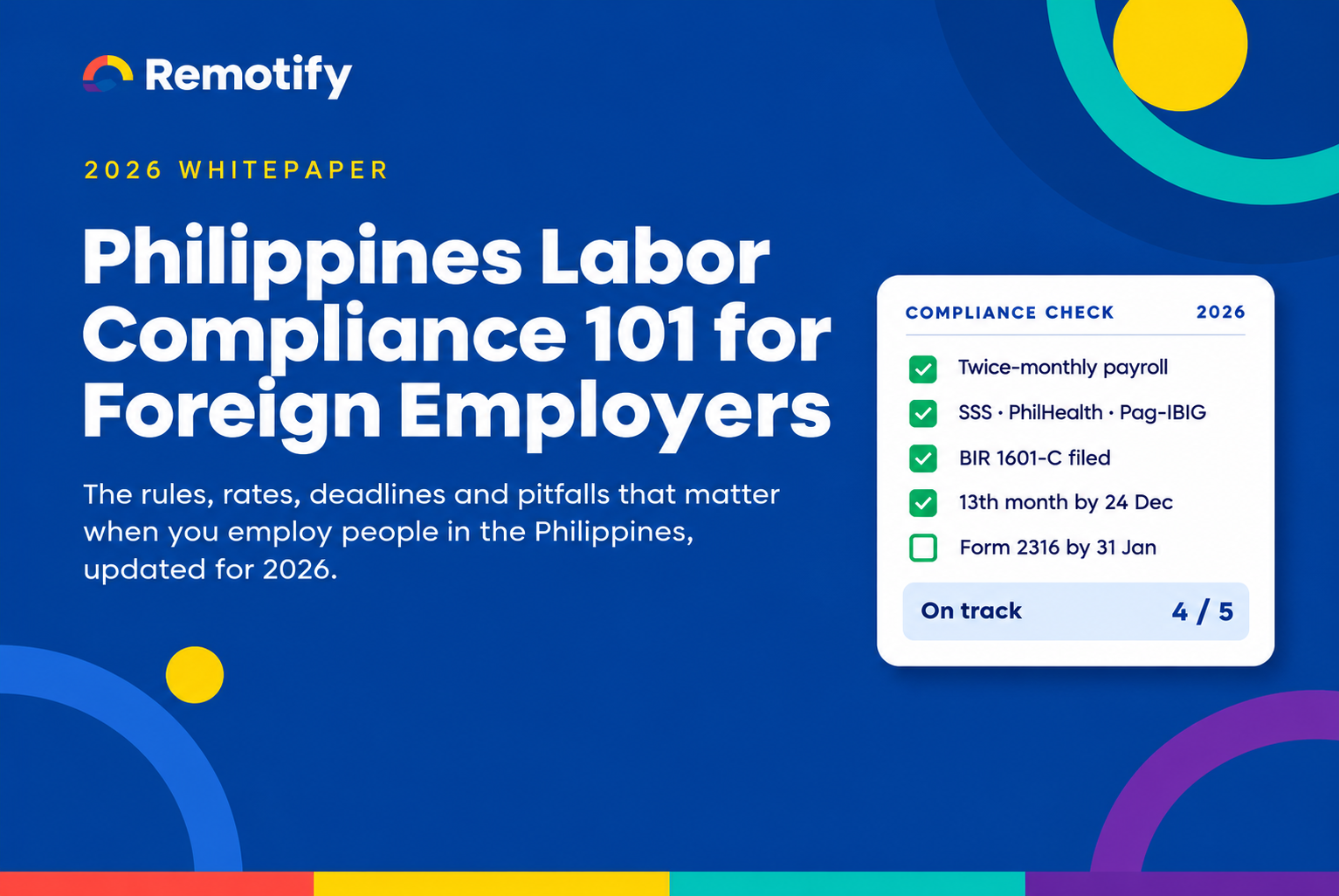
Remotify's 2026 Philippines Labor Compliance 101 Whitepaper provides a practical overview of Philippine employment regulations, helping foreign employers understand their responsibilities, manage employment costs and explore compliant hiring options, including using an Employer of Record (EOR) in the Philippines without establishing a local entity.
What's inside the whitepaper?
- Philippine labour laws and employment types: Understand the Labor Code, DOLE regulations, NLRC and different employment classifications.
- Wages, benefits and employment standards: Learn about regional minimum wages, working hours, overtime, holidays, leave entitlements and mandatory 13th-month pay.
- Statutory contributions: Explore 2026 SSS, PhilHealth and Pag-IBIG contribution rates, employer obligations and payment schedules.
- Payroll and tax compliance: Understand BIR withholding requirements, Forms 1601-C, 1604-C and 2316, along with important filing deadlines.
- 2026 compliance calendar: Keep track of monthly payroll responsibilities, statutory contribution deadlines and annual tax filings.
- Contractor vs. employee risks: Understand misclassification risks, potential liabilities and the legal considerations of engaging independent contractors.
- True cost of employment: Explore salary-based examples showing statutory employer contributions, 13th-month pay and the additional costs of employing Filipino talent.
- Hiring without a local entity: Discover how an Employer of Record in the Philippines can manage local employment, payroll, statutory contributions and compliance on your behalf.
Who is this whitepaper for?
This whitepaper is designed for founders, business owners, HR leaders, finance professionals and operations teams outside the Philippines who currently employ or plan to hire Filipino talent.
Whether you're hiring your first remote employee, managing an existing workforce, transitioning contractors to formal employment or exploring an Employer of Record in the Philippines, this guide will help you understand the regulations and responsibilities involved.
Stay informed and simplify employment compliance
Managing a remote workforce in the Philippines involves more than paying salaries. From statutory contributions and tax filings to employment contracts and mandatory benefits, understanding local requirements is essential to building a compliant and sustainable team.
Get practical insights into Philippine labour regulations, understand your employment costs and discover how you can employ Filipino professionals without establishing a local entity.
Download the free 2026 Whitepaper and take the next step towards compliant hiring in the Philippines.
FAQs
1. What are the employment compliance requirements for hiring in the Philippines?
Foreign employers must understand Philippine labour laws covering minimum wages, working hours, overtime, holidays, leave, 13th-month pay, statutory contributions and employment termination. They must also comply with payroll withholding and BIR reporting requirements.
2. Do foreign companies need a local entity to hire employees in the Philippines?
No. Foreign businesses can use an Employer of Record (EOR). The EOR acts as the local legal employer and manages employment contracts, payroll, statutory contributions, tax filings and employee benefits without requiring the foreign company to establish its own Philippine entity.
3. What are the mandatory statutory contributions in the Philippines?
Employers must enrol eligible employees in three government programmes: Social Security System (SSS), PhilHealth and Pag-IBIG. Both employers and employees contribute their respective shares, which must be remitted according to the applicable schedules.
4. Is 13th-month pay mandatory for employees in the Philippines?
Yes. Employees who have worked for at least one month during the calendar year are entitled to 13th-month pay. It is calculated as one-twelfth of the employee's total basic salary earned during the year and must be paid on or before 24 December.
5. What are the payroll and tax filing requirements for Philippine employers?
Employers must withhold income tax from employee compensation, file and pay monthly withholding taxes using BIR Form 1601-C, submit the annual information return through Form 1604-C and provide employees with Form 2316. Applicable deadlines must be followed.
6. What are the risks of hiring employees as independent contractors?
If an individual is treated as an employee under Philippine labour law despite being engaged as a contractor, the business may face retroactive liabilities, including back pay, 13th-month pay, leave entitlements, statutory contributions, penalties and potential dismissal claims.
7. How can an Employer of Record help with Philippine labour compliance?
An EOR manages local employment contracts, payroll, statutory contributions, BIR filings, mandatory benefits and other employment obligations through its registered Philippine entity. This allows foreign businesses to employ Filipino talent without setting up a local company.