

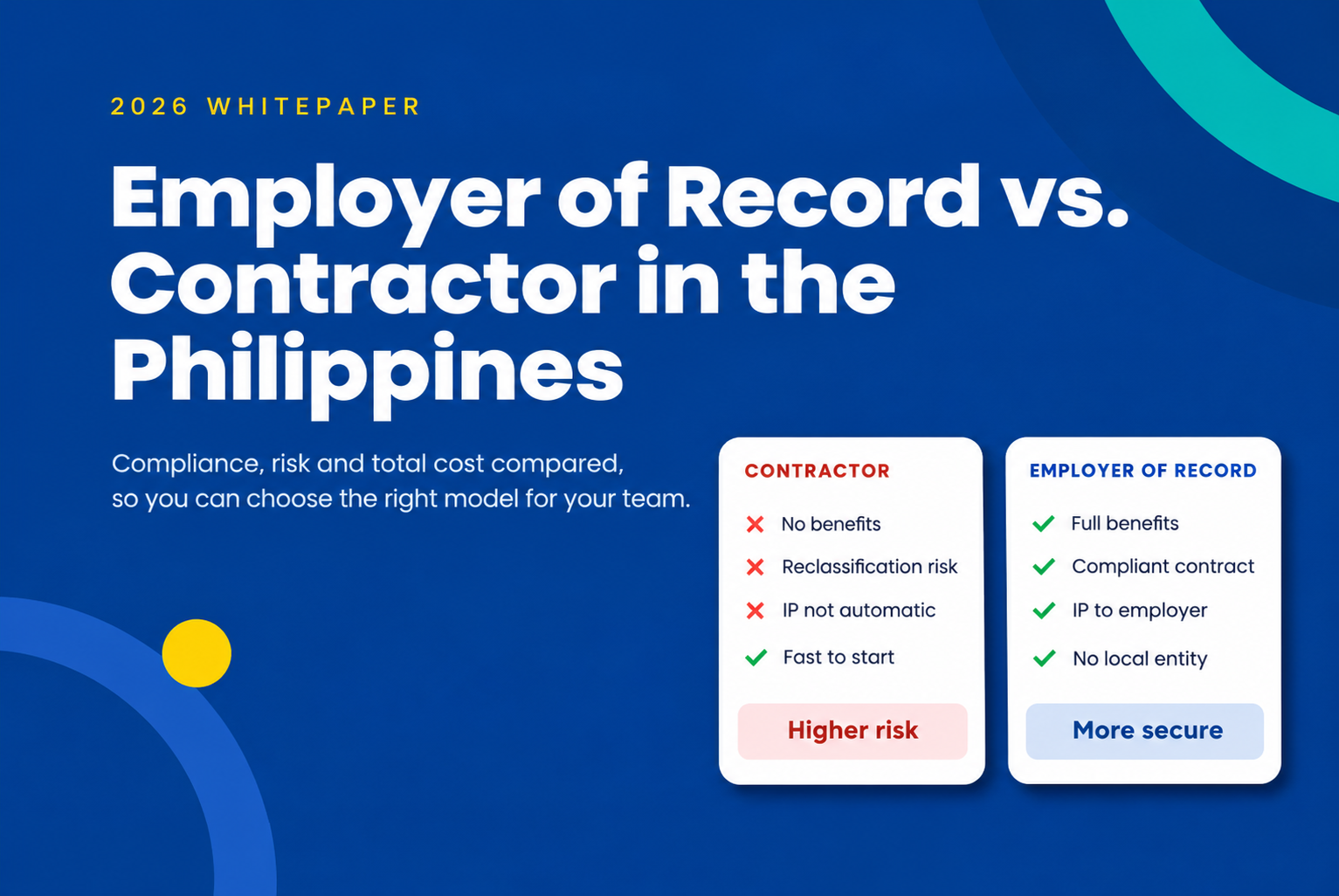
Hiring independent contractors in the Philippines can be a flexible and cost-effective way to build your remote team. However, when contractors work like full-time employees, businesses may face misclassification risks, unexpected liabilities and compliance challenges under Philippine labour laws.
Remotify's 2026 Whitepaper: Employer of Record vs. Contractor in the Philippines helps you understand the legal differences between both hiring models, evaluate the actual cost of employment and make informed decisions about managing your Filipino workforce.
What's inside the whitepaper?
- Philippine employment laws: Understand how Philippine courts and DOLE distinguish independent contractors from employees, including the four-fold test and economic dependence test.
- Misclassification risks and liabilities: Discover the potential financial and legal consequences of contractor misclassification, including back pay, statutory contributions, penalties and dismissal claims.
- Contractor vs. EOR comparison: Explore the differences between independent contractors and Employer of Record arrangements across compliance, costs, benefits, intellectual property and employee retention.
- True employment costs: Compare contractor and EOR expenses with practical examples based on 2026 Philippine salary and statutory contribution rates.
- Misclassification Risk Checklist: Access a practical checklist to evaluate your existing contractor arrangements and identify potential employment risks.
- Practical decision framework: Learn when to engage independent contractors, use a Contractor of Record or transition to an Employer of Record model.
Who is this whitepaper for?
This whitepaper is designed for founders, business owners, HR leaders, finance professionals and legal teams outside the Philippines who currently engage Filipino contractors or are planning to build a remote team.
Whether you're hiring your first Filipino professional, managing an established contractor workforce or considering converting contractors into full-time employees, this guide will help you understand your options and responsibilities.
Make the right hiring decision for your business
Choosing between an independent contractor and an Employer of Record in the Philippines is more than a payroll decision. It affects your compliance responsibilities, financial exposure, intellectual property ownership and long-term workforce stability.
Understand the risks, compare the actual costs and identify the right employment structure for your business with Remotify's 2026 Whitepaper.
Download the free whitepaper and make more informed decisions about hiring and managing talent in the Philippines.
CTA: Download the Free Whitepaper
FAQs
1. What is the difference between an Employer of Record and an independent contractor in the Philippines?
An independent contractor is a self-employed professional who generally manages their own taxes and contributions. An Employer of Record (EOR) employs professionals through its registered Philippine entity and manages employment contracts, payroll, statutory contributions and employee benefits on behalf of your business.
2. Can I hire independent contractors in the Philippines without an EOR?
Yes. You can directly engage independent contractors for genuine project-based work. However, if the working relationship involves fixed schedules, ongoing responsibilities, direct supervision and economic dependence, Philippine authorities may consider the individual an employee regardless of the contract label.
3. What happens if my contractors are classified as employees?
If a contractor is reclassified as an employee, your business may become liable for retroactive 13th-month pay, holiday and overtime pay, service incentive leave, SSS, PhilHealth and Pag-IBIG contributions, along with applicable penalties and potential dismissal claims.
4. How much does it cost to employ someone in the Philippines through an EOR?
The total cost generally includes the employee's base salary, employer contributions to SSS, PhilHealth and Pag-IBIG, 13th-month pay and the EOR service fee. For example, the whitepaper estimates that a ₱40,000 monthly salary results in approximately ₱48,063 in monthly employment costs before the provider fee, based on 2026 statutory rates.
5. When should I switch from contractors to an Employer of Record?
Consider an EOR when your contractors perform ongoing, core business functions, follow fixed working schedules, report directly to managers or work exclusively for your business. An EOR can provide formal employment, statutory benefits and locally managed payroll without requiring you to establish a Philippine entity.